

The Shifting Purpose of Schools

1.1 - Why We Built Schools the Way We Did
There is a reason most schools built in the last hundred years look roughly the same. Long corridors. Classrooms arranged off a central spine. A bell that moves students from one contained space to the next at fixed intervals. A teacher at the front, facing outward toward a room of similarly aged children, delivering the same content at the same pace.
This wasn't an accident, and it wasn't a failure of imagination. It was a design response to a specific set of conditions.
In the late 19th and early 20th centuries, rapidly industrializing economies needed workers who could follow instructions, maintain schedules, and function reliably within hierarchical systems. At the same time, waves of immigration and urban growth created pressure to educate large numbers of children quickly and at a cost communities could sustain. The school building that emerged from those conditions was genuinely fit for its purpose. Uniform room sizes reflected uniform content delivery. Fixed furniture reflected a fixed relationship between teacher and student. The corridor wasn't just a circulation path, it was a governance mechanism, a way of managing movement and maintaining order across a large institution.
The model was always a design response, not a universal truth.
The Reform Era and Its Honest Reckoning
For the past two to three decades, that model has faced a sustained and serious challenge. Small learning communities, personalized learning, flipped classrooms, STEAM integration, project-based and inquiry-based approaches: these weren't fringe ideas. They were grounded in genuine research about how learning actually works, backed by significant investment in professional development, and in many cases, reflected in building design. Flexible furniture replaced fixed rows. Walls came down to create collaborative spaces. Maker spaces and innovation labs appeared alongside traditional classrooms.
Some of it worked. In schools where reform was well-supported, where leadership was stable, where teachers had time to adapt and assessment systems evolved alongside pedagogy, these approaches produced real results. Students engaged differently. Learning felt more connected to the world outside the building.
But the honest reckoning is that the results were uneven, and the retreat was real. Open plan spaces from an earlier reform era got walls added back when the noise proved unworkable. Small learning communities produced complicated scheduling and inconsistent outcomes. Project-based learning thrived where a single committed teacher led it and quietly disappeared when that teacher left. Flipped classrooms assumed home access to technology and bandwidth that wasn't equitably distributed.
The pattern that emerged is worth naming directly, because it lives in the room whenever transformation is proposed today. Each reform was pedagogically sound in theory, partially implemented in practice, and evaluated against metrics that hadn't changed to match the new approach. The building sometimes changed. The assessment system and the institutional culture rarely did. When the reform stalled, the physical change looked like the problem. The result, for many district leaders and communities, was a reasonable return to the model that felt proven, stable, and defensible.
That skepticism isn't reactionary. It's earned.
The Pattern Repeats
Before leaving the reform era, one more chapter deserves a mention, because it's happening right now. A growing number of school districts are pulling back from one-to-one device programs. Parents are opting children into pen and paper. Several state legislatures are advancing bills to limit device use in early grades. Congressional testimony this past January named Gen Z as the first generation to score lower on standardized measures than the one before it, and pointed to unfettered screen time in classrooms as a contributing cause. That movement isn't a rejection of technology in principle. At its most useful, it's a rejection of technology deployed before the purpose question was asked. The critique that landed hardest wasn't that devices are harmful. It was that teaching students through computers replaced teaching them alongside computers, without the pedagogical, institutional, or physical conditions needed to make that shift work. Which is, again, the pattern. AI is arriving into that environment. The earned skepticism in the room isn't only about previous reform cycles. It's fresh, and it's specific. Any conversation about AI and school design that doesn't acknowledge it is starting from a position that much of its audience won't trust.
What does the building need to make possible, and what role, if any, should the screen play in that?
Why This Moment Is Structurally Different
AI is not arriving into a blank slate. It's arriving into a room full of people who have been promised transformation before and watched it fall short. That context matters enormously for how this conversation needs to be held.
What distinguishes this moment isn't the scale of the technology's ambition. Previous reform waves were also ambitious. What's different is where the pressure lands. Every prior reform worked at the edges of the core transaction of schooling: the teacher, facing the room, transferring knowledge to students. Personalized learning tried to differentiate within that structure. Project-based learning tried to reframe it. AI begins to substitute for part of that function directly. When a student can access a patient, personalized, and infinitely available explanation of any concept at any moment, the question of what the room is for starts to shift in a way that previous reforms could only gesture toward.
That shift doesn't settle the question of what the room should become. There is substantial evidence that human connection, the relationship between a teacher and a student, the friction and trust of learning alongside peers, is not incidental to good learning. It may be central to it. What AI changes is not the value of that human dimension, but the pressure on institutions to be more intentional about it. If the building no longer needs to be organized around information transfer, the question becomes: what conditions does it need to create instead?
This series begins here because the design decisions being made right now, about buildings that will serve communities for thirty to fifty years, are being made by people carrying the memory of what transformation has cost before. That memory deserves respect. So does the question it leaves open.
What is the school building designed to do now?

1.2 What are we actually teaching for?
The question sounds simple enough. Ask most people why children go to school and the answer comes quickly: to prepare for the future. To get a good job. To build a productive life.
For most of the last century, that answer was coherent. The path was legible. School led to credential, credential led to employment, employment led to a stable adult life. The system wasn't perfect, and access to that path was never equally distributed, but the logic held well enough that it organized everything: what was taught, how progress was measured, and what success looked like when a student walked out the door for the last time.
That logic is loosening. Not breaking overnight, but loosening in ways that are already visible and that AI is accelerating.
The Credential Is No Longer the Destination
The relationship between formal education and employment has been under pressure for some time. Career paths that once moved in a relatively straight line now bend, branch, and restart multiple times across a working life. Industries that didn't exist a decade ago now employ millions. Skills that were considered durable have shorter half-lives. Employers in a growing number of sectors are quietly stepping back from degree requirements, less because credentials don't matter and more because the credential alone no longer reliably signals what it once did.
AI adds a specific pressure to this picture. It isn't eliminating work so much as it is reorganizing it, shifting which tasks require human judgment and which don't, and doing so at a pace that outruns the curriculum cycles of most school systems. A student entering kindergarten today will enter a workforce in roughly 2038. The jobs waiting for them, and the skills those jobs will require, are only partially visible from here.
This isn't a reason for panic. It is a reason to ask a harder question than school systems have generally been willing to ask: if the employment destination is less certain and less fixed than it once was, what should be organizing the curriculum instead?
What the Reform Era Was Reaching For
This is where the previous two decades of educational reform become relevant again. The shift toward project-based learning, inquiry-based approaches, and social-emotional development wasn't arbitrary. It reflected a growing sense, backed by research, that the skills most resistant to automation and most valuable across a shifting economy were not the ones most easily measured on a standardized test. Critical thinking. Collaborative problem-solving. Ethical reasoning. The ability to learn something new when the situation demands it.
The reform era was, in part, an early attempt to answer the purpose question before it became urgent. That it produced uneven results doesn't invalidate the instinct. It suggests the instinct was right but the institutional conditions, the assessment systems, the professional development structures, the physical environments, weren't fully aligned to support it. AI makes that alignment question impossible to defer.
Holding the Tension
There is no clean answer to what school is for if not primarily for jobs. That's worth saying directly, because both district leaders and designers will be skeptical of anyone who claims otherwise.
What there is, instead, is a productive reframing. If the employment destination is less fixed, then the more durable purpose of school might be something closer to this: developing people who can navigate uncertainty, build meaningful relationships, think clearly under pressure, and contribute to communities they care about. Those capacities have always mattered. What's changing is that they can no longer be treated as secondary to content acquisition. They may need to become the organizing logic of the system itself.
That reframing has spatial consequences. A building organized around content delivery looks different from a building organized around the development of those capacities. Not completely different, but different in ways that matter when decisions about corridors, room sizes, adjacencies, and shared spaces are being made.
The pieces that follow in this series are largely concerned with what those differences look like in practice. But they rest on this question, which every district leader and every design team would benefit from sitting with before the brief is written:
What are we building this for?
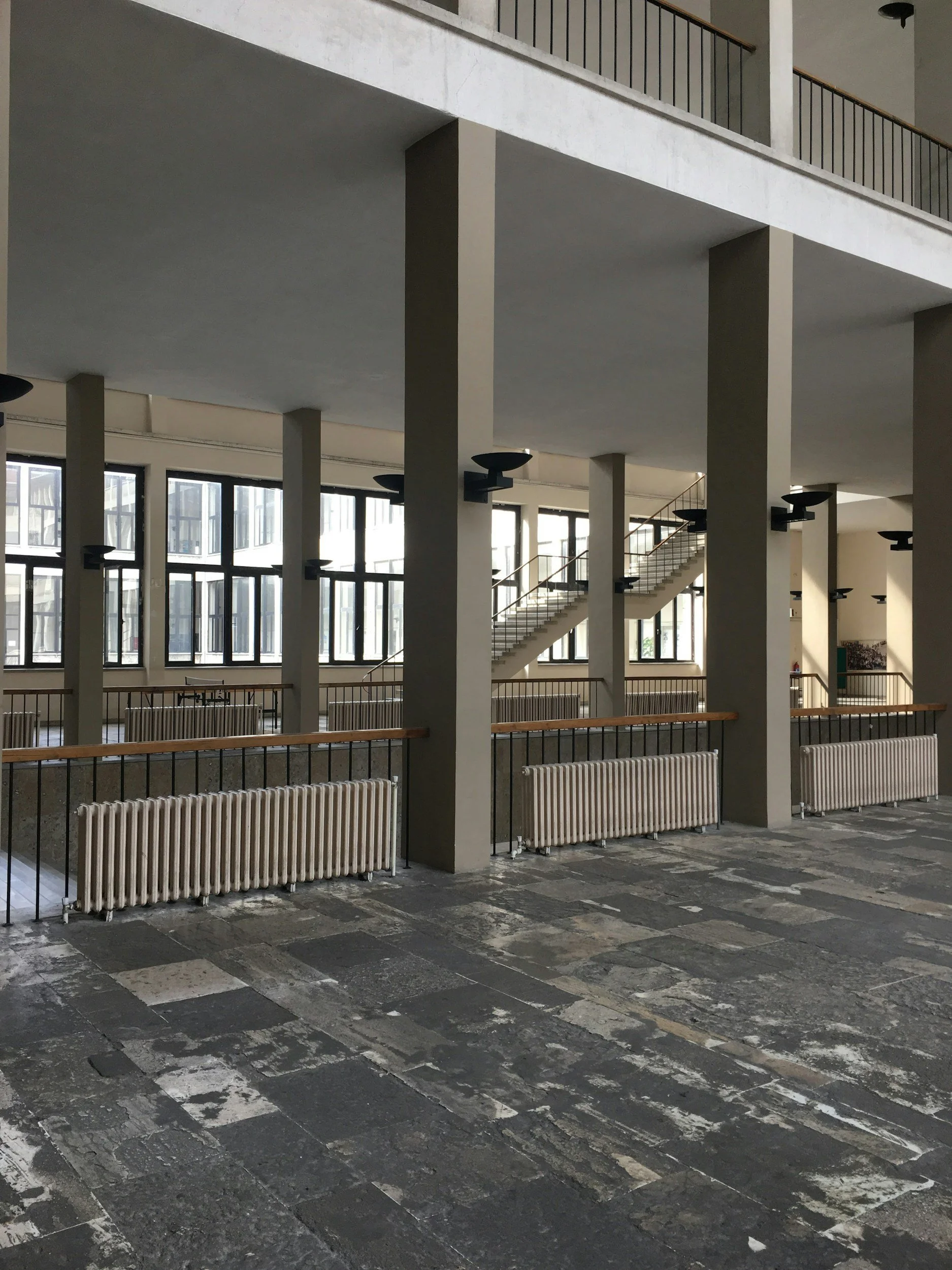
1.3: Building for a Future That Isn't Fully Visible Yet
There is a particular kind of pressure that district leaders and design teams share that rarely gets named directly in conversations about AI and education. It isn't the pressure to adopt new technology. It isn't the pressure to prepare students for an uncertain future. It's something more immediate and more consequential than either of those
It's the pressure of making irreversible decisions inside a reversible situation.
A school building approved for funding today will likely break ground in two to three years and open its doors one to two years after that. The communities it serves will use it for fifty years, sometimes longer. The decisions made in the planning and design process, about size, configuration, room mix, structural systems, and relationship to the surrounding neighborhood, will still be expressing themselves in 2070 and beyond. And they are being made right now, while the pedagogical picture is still forming and the pace of AI adoption in classrooms is faster than any curriculum committee can formally process.
This isn't a crisis. But it is a genuine design condition, and treating it as anything less doesn't serve the people who have to make these decisions.
What the History of Reform Tells Us
The timing problem isn't new. It has accompanied every significant shift in educational thinking. Schools built during the open-plan movement of the 1970s encoded a pedagogical philosophy that was already being questioned before many of them opened. Schools built to support small learning communities in the 1990s and 2000s sometimes found themselves physically misaligned with the very reforms they were meant to house by the time construction was complete. The one-to-one device programs of the last decade followed the same arc: technology deployed at scale before the pedagogical and institutional conditions needed to support it were in place, with consequences that are still being sorted out in school board meetings today.
The pattern is consistent enough to take seriously. Buildings are slow. Ideas move faster. And the gap between them has consequences that last for decades.
What's different now is the rate of change. The shifts in practice that followed previous reform movements unfolded over years and decades, giving communities some time, however imperfect, to observe and adjust. The integration of AI into learning environments is moving faster, and it is moving faster simultaneously across geography, institution type, and age group in ways that previous reforms did not. That acceleration doesn't mean decisions should be rushed. It means the decisions that can be deferred should be identified clearly, and the ones that can't should be made with the best available thinking rather than defaulting to the familiar.
The Difference Between Reversible and Irreversible
Not all decisions made during a school planning process carry the same consequences. This is where the timing paradox becomes manageable rather than paralyzing.
Some decisions are difficult or expensive to reverse once made. The size and footprint of a building. Its structural system. Its relationship to the street, the neighborhood, and the community it serves. The number and configuration of large shared spaces versus smaller enclosed rooms. These decisions deserve the most careful thinking about an uncertain future, because they will still be expressing themselves long after the technology landscape has shifted again.
Other decisions are more recoverable. Furniture and interior configuration can change. Technology infrastructure can be upgraded. Room assignments can shift as programs evolve. A space designed with adaptability as an explicit principle, with floor-to-floor heights that allow flexibility, with structural bays that don't dictate a single use, with technology infrastructure that anticipates change, has more room to respond to what the future actually brings rather than what the planning team predicted it would bring.
The practical implication isn't complicated, though it requires discipline to apply consistently. Design toward the decisions that are hard to undo. Hold lightly the decisions that aren't.
What This Asks of Both Audiences
For district leaders, the timing paradox asks for a particular kind of intellectual honesty in the brief-writing process. It means resisting the temptation to specify a building around a single pedagogical model that may evolve, and instead articulating the range of futures the building needs to be able to serve. That's a harder conversation to have with a community during a bond campaign, but it produces better buildings.
For architects and designers, it asks for something similar: the discipline to distinguish between what a client is asking for today and what the building will need to support across its full life. That distinction is one of the most valuable things a design team can bring to a project, and it becomes more valuable as the pace of change accelerates.
Neither audience is being asked to predict the future. They're being asked to make decisions that remain useful across a range of futures they can't fully see
That's not a new ask. It's what good planning has always required. What's changed is how explicitly it needs to be named.