

What this Mean for Places
A Different Design Problem
The pieces in this series so far have been circling a question that most conversations about AI and education approach carefully, if they approach it at all.
Here it is directly: if AI continues to reorganize which tasks require human judgment, and if that reorganization accelerates at the pace already visible in specific industries and specific kinds of work, the employment rationale that has organized public education for over a century begins to loosen in ways that are genuinely difficult to sit with. Not just at the edges, where credential value is shifting and career paths are less linear, but at the center. If the work school was preparing students to do is being fundamentally reorganized, the question of what school is for doesn't have a ready answer.
That question deserves to be named, not smoothed over. And it is the question that every design decision being made about school buildings right now is either taking seriously or quietly ignoring.
What Movement Two Left Open
The previous pieces in this series examined the shift from the inside: what it feels like to be a student navigating a room organized around a function that AI is redistributing. What it feels like to be a teacher whose professional expertise is being reorganized by a technology their students use more fluently. What it means for a community when the building that anchored its daily rhythm is being asked to become something different. And whose needs have historically been underserved by the assumptions embedded in the design of the spaces where all of this is happening.
None of those pieces resolved the underlying question. They weren't meant to. They were meant to make it visible in human terms, because the design response to that question is only as good as the understanding of what the people inside the building are actually experiencing.
What they left open is the spatial dimension: if the conditions have shifted, what is the building now being asked to resolve?
The Purpose Question Has a Design Consequence
There is no settled answer to what school is for if its primary rationale is loosening. That's worth saying directly, because both district leaders and design teams will be skeptical of anyone who claims otherwise.
What there is, instead, is a reframing that the evidence already supports. The capacities most valuable across a shifting and uncertain future, the ability to navigate complexity, to build trust and relationships, to think clearly under pressure, to apply understanding to problems that haven't been encountered before, are not capacities that information delivery was ever well designed to develop. They require something different from the environment. They require conditions for what students do with knowledge, not just conditions for receiving it.
That reframing is not a consolation for the disruption. It is a genuine and grounded answer to the purpose question, one that the reform era was reaching for before it became urgent and that AI has now made harder to set aside. A school organized around developing those capacities looks different from a school organized around content delivery. Not entirely different, but different in ways that matter when decisions about room sizes, adjacencies, structural systems, and community relationships are being made.
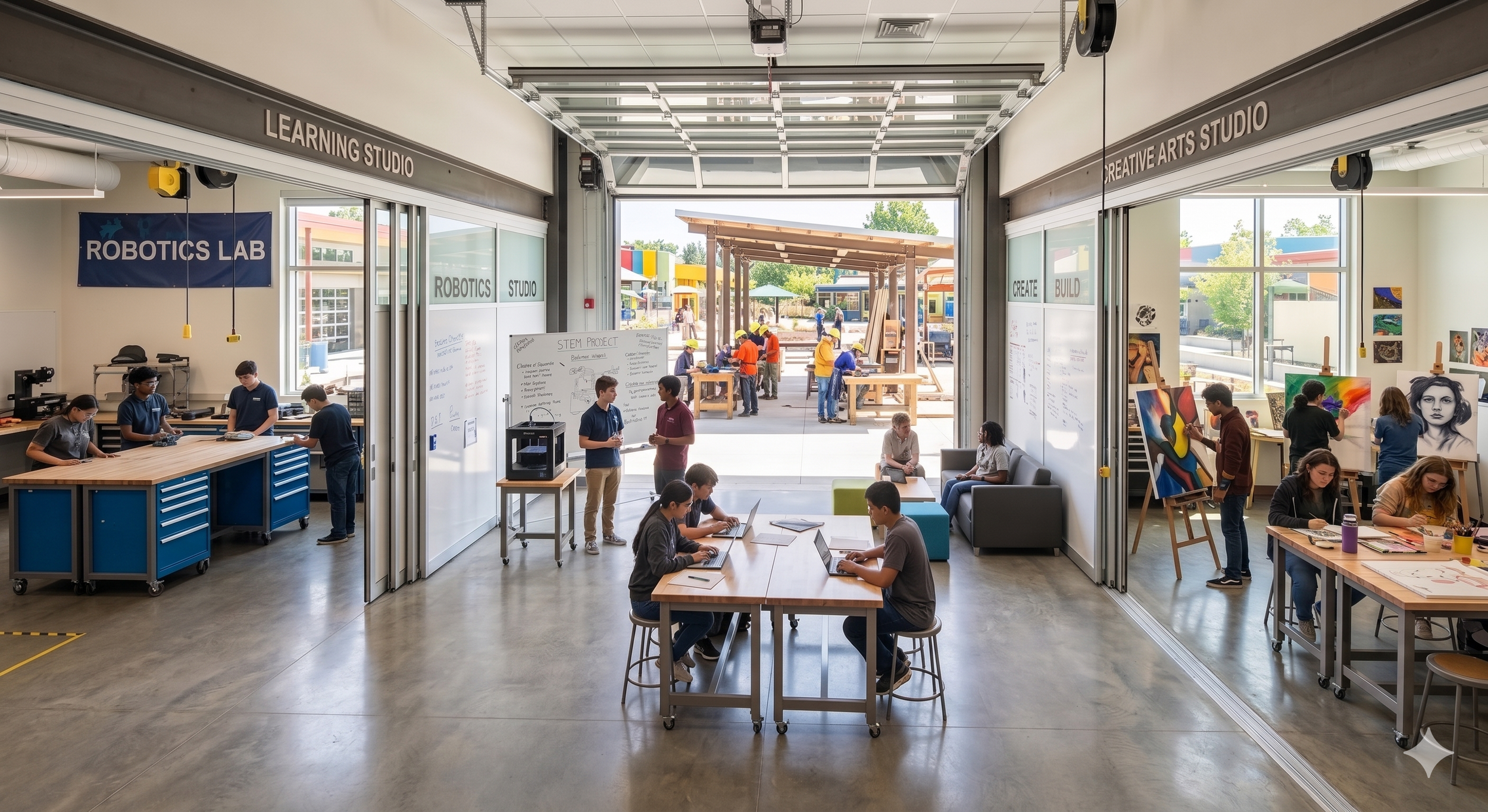
This is what the application hub idea actually means, stripped of the design vocabulary that has made it easy to invoke and easy to dismiss. It is not modular furniture and writable walls. It is a building organized around what students do with knowledge rather than how they receive it: applying it to real problems, testing it against other people's thinking, building things that didn't exist before, navigating the friction and trust of working alongside peers and adults in a shared physical space. Those activities are what AI cannot replicate. They are what the building can uniquely make possible. And they are what the design of the building either supports deliberately or undermines quietly.
What This Movement Will Do
The pieces that follow get specific. Not in the sense of prescribing a single model, because the series has been clear throughout that the range of futures the building needs to serve is too wide for any single answer. But specific in the sense of naming the decisions that matter, the tradeoffs that are real, and the thinking that remains useful across the uncertainty.
The classroom typology, the single most powerful constraint on reimagining school buildings, gets examined directly: what it has been holding, which of those functions AI is changing, and what the building needs to provide in its place. The question of what a school organized around application actually contains, how its room mix changes when delivery is no longer the primary function, gets examined through the lens of existing precedents and the specific spatial consequences of the shift. The practical design principles that distinguish decisions that lock in a single pedagogical moment from those that remain useful across a range of futures get developed into territory directly applicable to brief-writing and planning conversations.
One dimension running through all of those pieces deserves naming here: the shift doesn't land uniformly across age groups, and the buildings in a community are not independent projects. They are a connected sequence, each doing something specific for the developmental stage it serves, each preparing the student for what comes next. The spatial consequences of the AI transition look different in an elementary school organized around the foundational work of early childhood than in a high school organized around application and genuine independence. And the quality of what the high school can ask of its students depends significantly on what the earlier buildings in the sequence were designed to develop.
Given what we know about how slowly buildings change relative to the conditions they are responding to, the decisions being made right now will still be expressing themselves when the technology landscape looks entirely different from what it looks like today. The purpose question, what is school for, will still be present in the building whether or not it was consciously addressed in the design process.
“If the building is no longer primarily organized around delivering information, what is it organized around, and who decides?”
Table of Contents
3.1: The School as Application Hub
Ask someone to picture a school and the image that arrives is almost always the same. A corridor lined with doors. Classrooms arranged off a central spine. A teacher at the front, facing outward. The image is so familiar it barely registers as a choice. It feels less like a design decision and more like a definition: this is what a school looks like, because this is what a school is.
That image is the single most powerful constraint in the conversation about what schools need to become.
Not the funding formula, not the regulatory framework, not community resistance to change, though all of those are real and consequential. The deepest constraint is the mental model of the classroom itself, the assumption, so thoroughly embedded it operates below conscious decision-making, that a school is a collection of rooms where teachers deliver content to groups of similarly aged children. Every alternative proposal gets evaluated against that image. And most of them lose, not because they are pedagogically unsound, but because they don't look like school.
What the Classroom Was Actually Doing
The persistence of the classroom typology isn't simply inertia. The classroom has been doing several things simultaneously, and the design conversation tends to undercount them.
It was delivering content, yes. But it was also providing structure and supervision for a predictable number of students across a predictable day. It was organizing funding, because most state allocation models are built around classroom counts and teacher-to-student ratios. It was satisfying regulatory requirements written around the assumption of enclosed instructional spaces. It was anchoring the school day as a community service, the structured time that allows parents to work and families to organize their lives. And it was providing the teacher with something that rarely gets named in design discussions: a professional home. A space that belongs to them, that they can arrange and decorate and inhabit in ways that make their practice legible, to their students and to themselves.
That last function matters more than the design conversation usually acknowledges. In a profession where institutional control over time, curriculum, assessment, and evaluation is considerable, the classroom is often the one domain where the teacher's judgment is largely sovereign. Ask a teacher to give up the classroom and you are asking them to give up more than a room. You are asking them to give up the spatial anchor of a professional identity that the rest of the institution has given them relatively little room to express.
Any serious conversation about reimagining the school building needs to start by acknowledging the full weight of what the classroom typology is holding. Proposals that skip this step tend to generate the kind of resistance that looks like stubbornness but is really something more reasonable: people protecting functions the proposed alternative hasn't accounted for.
Sorting the Functions
The more productive question isn't whether to keep the classroom. It's which of the classroom's functions AI is changing, which it isn't, and what each of those functions actually requires of a space.
Content delivery is changing most directly. When a student can access a patient, personalized, and infinitely available explanation of any concept at any moment, the room organized primarily around a single adult transmitting content to thirty students becomes harder to justify on those terms alone. That doesn't mean instruction disappears. It means the moments when a skilled teacher brings a room together around a shared idea, a discussion, a demonstration, a collectively navigated problem, become more valuable and more visible as the primary function of instructional time rather than a supplement to content transfer.
Supervision and accountability are changing more slowly. The institution still needs to know where students are and what they are doing. But the spatial logic of supervision, the room that keeps everyone visible to one adult with line-of-sight authority, may have more flexibility than it appears. Teams often navigate this by designing for transparency rather than containment: spaces where activity is visible across a larger area without requiring every student to be in the same enclosed room.
Peer relationship and collaborative work are not changing in ways that reduce their importance. If anything, AI makes the conditions for genuine human interdependence more valuable, not less. A student who can get content and feedback from a device needs the building to provide something the device cannot: the experience of working through something genuinely difficult with other people, in real time, in a shared physical space. That function requires rooms configured for groups rather than rows, with acoustic conditions that support focused conversation, and adjacencies that allow different kinds of work to happen in proximity without interfering with each other.
The teacher's need for professional grounding doesn't disappear in any of these configurations. It requires a different spatial answer. Dedicated planning and preparation spaces that belong to a teacher or a team of teachers. Storage and display that carries the markers of professional identity. A home base that provides the psychological anchor the classroom currently supplies, even if the instructional time itself happens across a wider range of spaces.
What Permission Looks Like
Given what we know about how deeply the classroom assumption is embedded in funding formulas, regulatory frameworks, and community expectations, design teams and district leaders rarely encounter a blank slate. The question isn't usually whether to reimagine the school from scratch. It's where in a specific project the classroom assumption is most open to examination, and what it would take to create permission for a different answer in that particular context.
In some projects, the permission lives in the brief: a district leader willing to write program requirements around learning functions rather than room counts, opening space for a design team to propose configurations the standard template wouldn't generate. In others it lives in the community engagement process: a conversation that starts not with floor plans but with questions about what families actually need the building to do, which sometimes surfaces functions the classroom model was never fully serving.
In a common pattern across projects where this shift has been attempted, the most durable changes tend to be the ones that found a way to answer the classroom's functions rather than simply removing them. The teacher who lost a dedicated classroom but gained a professional suite with colleagues found the transition workable. The one who lost the classroom and gained a shared open space with no clear professional home often didn't.
The application hub idea, the school organized around what students do with knowledge rather than how they receive it, is a sound reframing. Making it real requires working through what the classroom was holding and designing deliberate spatial answers for each of those functions. The buildings that do that work tend to feel like schools that have become something more. The ones that don't tend to feel like schools with the walls removed.
“In your next project, which of the classroom’s functions is most open to reimagining, and what would the building need to provide in its place?”

3.2: What Should a School Actually Contain?
Every school building program begins from an inherited room count.
So many classrooms of this size. An administration suite of this configuration. A cafeteria sized for this many students at two sittings. A gymnasium, a library, support spaces distributed according to ratios that have been refined over decades into something that feels less like a design decision and more like a natural law. The proportions are so stable, so consistently reproduced across districts of every size and geography, that most planning teams treat them as a starting point rather than a question.
They are a question. And the shift in what school buildings are being asked to do makes it one worth asking directly: if a school were designed from scratch for the conditions this series has been describing, what would it actually contain, and in what proportions?
The Room Count Reflects the Function It Was Designed For
Current school programs typically dedicate between forty and sixty percent of usable square footage to classrooms, depending on grade level and program type. That proportion reflects a building organized around content delivery: the classroom is the primary unit, everything else supports it. Administration manages the institution. The cafeteria fuels the bodies. The gymnasium provides the physical release. The library holds the resources. And the classrooms, arranged off corridors in repeating modules, do the central work of moving knowledge from teachers into students across a structured day.
That proportion made sense for the function it was serving. It makes less sense if the function is shifting.
A school organized around application, collaboration, and the kinds of thinking that require other people has a different room mix. The spaces where students work together on complex problems, where they build and make and present and critique, where they connect with adults beyond the teaching staff and engage with questions that don't have predetermined answers, are not support spaces in that model. They are primary. The classroom in its traditional form, a contained room sized for one adult to address thirty students simultaneously, becomes one tool among several rather than the organizing unit of the entire building.
Asking what proportion of a school's square footage should be dedicated to classrooms in that model is not a rhetorical question. It is a practical one with real consequences for structural systems, mechanical distribution, room sizing, and cost. And it is a question that most school building programs have never been formally asked to answer.
A Useful Precedent
The skill center offers a concrete and already-tested precedent for what an inverted program looks like in practice.
Skill centers, regional facilities typically serving multiple high schools in career and technical education, health sciences, performing arts, or advanced manufacturing, are organized around application rather than delivery from the outset. Students arrive to do something: to build, to practice, to apply knowledge under conditions that approximate real professional environments. The room mix reflects that organizing principle. Large making and fabrication spaces. Flexible project areas sized for teams. Critique and presentation spaces designed for an audience. Smaller rooms for focused individual or small group work. Content instruction happens, but it is a smaller fraction of the total program, delivered in service of the application work rather than as the primary activity the building is organized to support.
The skill center doesn't solve every problem. Students travel to it, which complicates the supervision predictability that families depend on and that Piece 2.3 named as foundational to how working households organize their days. Coordination between home schools and the skill center requires scheduling discipline that not every district manages well. And the model, as currently implemented, tends to serve older students in specialized programs rather than the full K12 population across all subjects.
But as a spatial argument, the skill center makes something visible that the standard school program keeps invisible: it is entirely possible to build an educational environment where application spaces are primary and content delivery spaces are secondary, and for that environment to function well, to feel purposeful, and to produce genuine engagement from the students inside it. That existence proof matters when the conversation turns to what a school for the AI generation might actually contain.
The skill center precedent shifts the argument about what rooms need to do. There is a related question the inherited program has been equally slow to ask: who the rooms need to contain.
The standard classroom groups students by age because it was organized around uniform content delivery. When AI assumes much of that function, delivering personalized content to each student at their individual pace, the strongest justification for age-sorted cohorts softens. What remains is the human dimension of school: peer mentoring, collaborative work, the social experience of learning alongside people at different stages. Those functions do not require age homogeneity. Research consistently suggests they benefit from the opposite.
Montessori classrooms have operated on this logic for more than a century, grouping students across three-year age spans and organizing the room around what each child is ready to do rather than what the cohort is scheduled to receive. Where the supporting conditions were in place, the approach produced genuine results. Where they were not, the results were thinner. That pattern holds. What is different now is that AI shifts one of those conditions directly: the content-delivery burden on a teacher working across a multi-age group is reduced when each student has a tool managing their individual content exposure. A small number of schools are already combining AI-driven personalization with multi-age grouping, and the spatial model that emerges looks different from the inherited program. Not uniform rooms sized for same-age cohorts receiving the same lesson, but varied configurations supporting groups working at different stages on shared problems. The implications for room size, adjacency, and the proportion of enclosed instructional space are real, and they deserve to be examined alongside the question of what the building contains.
The Program Question at Different Ages
The room mix question doesn't have a single answer across the full span of K12 education, and treating it as though it does produces buildings that serve no age group as well as they could.
An elementary school organized around the conditions young children actually need for development looks different from the inherited program in specific ways. Physical exploration, sensory richness, unstructured making, the social work of learning to be in a community: these functions require generous, varied spaces that current elementary programs often underinvest in relative to the classrooms they prioritize. The proportion of informal, flexible, physically rich space in a well-designed elementary building is higher than the standard program reflects. Outdoor learning environments, making spaces scaled to small hands and big curiosity, quiet corners for a child who needs to withdraw before re-engaging: these are not luxuries. They are the spatial conditions for the developmental work that elementary school is actually for.
A high school organized around the application hub idea looks more like the skill center precedent than the current inherited program. Larger project and making spaces. More varied room sizes to support different kinds of work at different scales. Presentation and critique spaces designed for real audiences rather than the teacher alone. Stronger physical and programmatic connections to the community outside the building, to professional environments, community organizations, and the kinds of problems that don't have textbook answers. Fewer uniform classrooms sized for thirty students receiving content from one adult. The proportion of dedicated classroom space in that model is likely to be meaningfully lower than the current forty to sixty percent, with the released square footage redistributed toward the application and collaboration spaces that the building's primary function now requires.
The middle school sits between those two, developmentally and spatially. The social complexity and identity formation of early adolescence requires environments that support both structured community and individual agency, spaces that feel neither like the protected enclosure of the elementary building nor the open-ended independence of a well-designed high school. Getting that balance right in the room mix is genuinely difficult, and it's an area where the inherited program has been least successful.
What the Program Question Requires of Both Audiences
The consolidated school model, for all its limitations, answered real needs that any reconfiguration has to account for. The predictability of a single site for supervision and safety. The shared investment in athletic facilities, performance spaces, and the extracurricular programs that are, for many students, the primary source of belonging and engagement. The community identity that a school's sports teams, performances, and shared events create for the neighborhood around it. These are not trivial. They are reasons the consolidated model has persisted even when its educational limitations were apparent, and they are constraints that any serious reimagining of the program needs to address rather than assume away.
The program question doesn't require abandoning any of those functions. It requires asking which of them genuinely need to be housed in the same building as the everyday learning environment, and which could be served differently, perhaps through shared community infrastructure that multiple schools and their surrounding neighborhoods invest in together, without compromising the learning environment's ability to do its primary work.
Given what we know about how planning processes default to familiar proportions under time and budget pressure, the program question is most likely to produce a different answer if it is asked explicitly and early, before the room count is treated as settled. For district leaders, that means writing briefs that specify functions and outcomes rather than room counts, and asking design teams to propose the program that serves those functions rather than to optimize a predetermined one. For design teams, it means bringing the program question to the client before the schematic phase rather than after, and being willing to propose proportions that look unfamiliar precisely because the conditions they are responding to are genuinely new.
The inherited room count is not a natural law. It is a design response to conditions that are changing. The question of what should replace it is one of the most consequential a planning team can ask, and one of the least frequently posed.
“If you started from the functions your community most needs the building to serve, rather than from the room counts it has always contained, what proportion of the building would still be dedicated to classrooms, and what would occupy the rest?”
3.3: Building for Uncertainty
The most consequential decisions in a school building project are rarely the ones that feel most significant in the room where they are made.
The choice of a school's name. The color palette in the renderings. The furniture specification. These generate discussion, sometimes extended discussion, because they are visible and legible and feel like expressions of what the community values. They are also, in most cases, among the most recoverable decisions in the entire project. A color can be repainted. Furniture can be replaced. A name can, with enough community will, be changed.
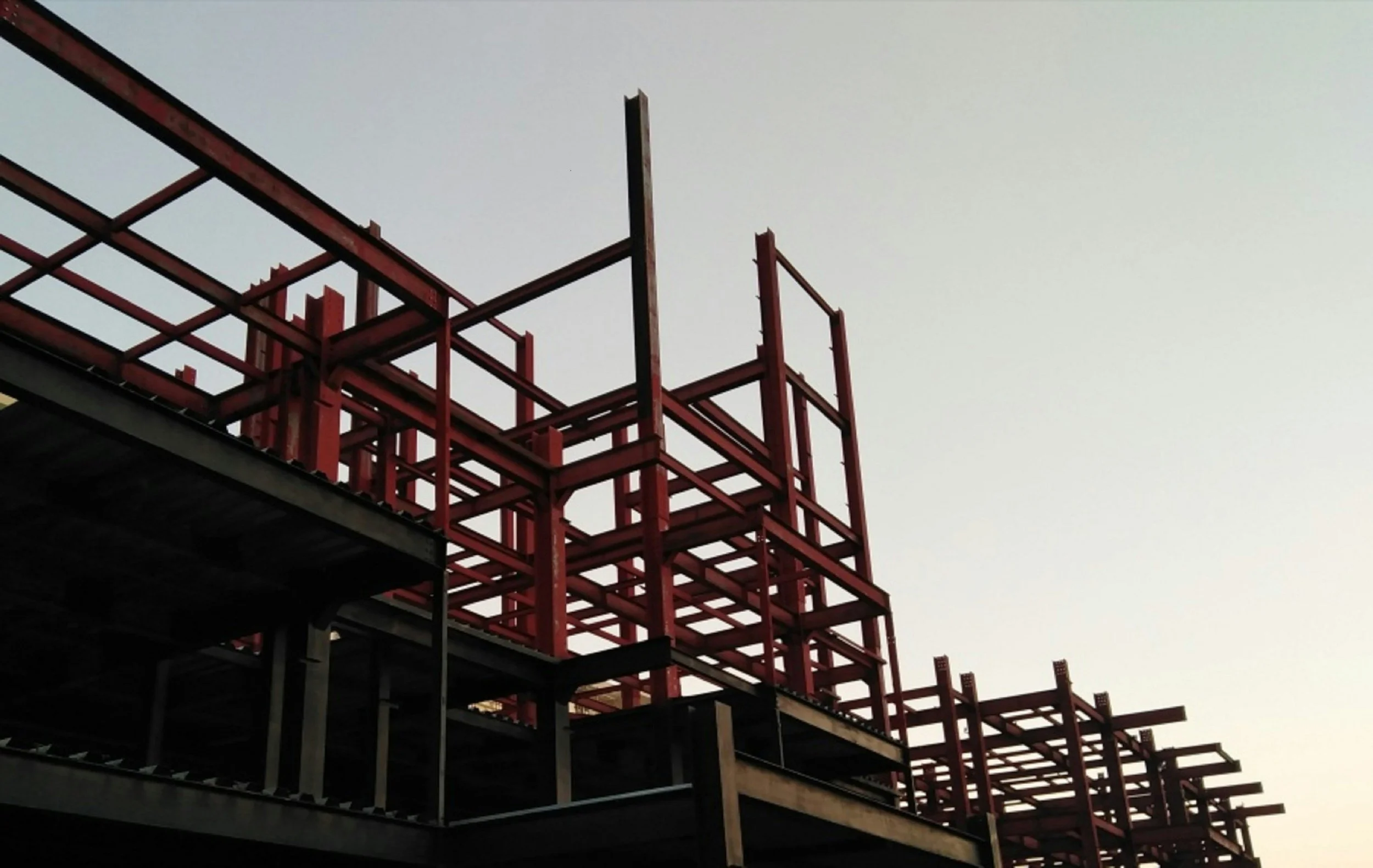
The decisions that will still be expressing themselves in forty years tend to feel more technical. The structural grid and bay spacing. The floor-to-floor height and how much it allocates for mechanical infrastructure versus usable volume. The ratio of enclosed rooms to open and semi-open space. The distribution and capacity of technology pathways through the building. These decisions are made early, often in schematic design before the full planning team is assembled, and they are rarely framed as the philosophical choices they actually are.
They are philosophical choices. And making them well, in a moment when the conditions the building needs to serve are shifting faster than any previous generation of school designers has had to navigate, requires a specific kind of discipline: the discipline to distinguish between what is actually irreversible and what only feels that way, and to apply the most careful thinking to the decisions that genuinely fall into the first category.
What Irreversibility Actually Means
The reversible/irreversible framework introduced earlier in this series is not a design methodology. It is a way of organizing attention during the planning process so that the decisions with the longest consequences receive the most deliberate examination.
Not every decision that feels permanent is genuinely irreversible. A room designated as a classroom today can become a project studio tomorrow if the structural grid is generous enough and the mechanical infrastructure is accessible enough to accommodate the change. A corridor that currently functions as pure circulation can become a learning landscape if the spatial conditions allow it. The building's capacity to absorb those changes without major structural intervention is itself a design decision, made during the schematic phase, that either expands or forecloses future options for decades.
The decisions that are most genuinely difficult to reverse cluster around a building's fundamental geometry and systems. The footprint and its relationship to the site, the street, and the surrounding neighborhood. The structural system and the bay spacing it produces. The floor-to-floor height and what it allows in terms of both mechanical infrastructure and spatial variety. The number, size, and configuration of large shared spaces relative to smaller enclosed rooms. These decisions are expensive to change after construction and in some cases practically impossible. They deserve to be examined not only in terms of what they enable today but in terms of what they foreclose for the building's full life.
A common pattern in projects that age well is that the early design decisions were made with an explicit awareness of which assumptions they were encoding and which they were leaving open. A structural grid sized generously enough to allow a range of room configurations without requiring structural modification. Floor-to-floor heights that allocate enough plenum depth for mechanical flexibility and enough usable volume to allow spatial variety within a single floor: spaces that feel different from each other, that offer a range of acoustic and volumetric experiences, rather than a single uniform condition repeated across the building. Technology pathways designed with conduit capacity well beyond current need, on the reasonable assumption that what the building will need to carry in twenty years is not fully knowable today. These are investments in optionality, made at the beginning of a project when they are relatively inexpensive, that pay forward across the building's full life.
The Assumptions Encoded in Structure
The supervision-versus-agency tension that has run through this series since Movement Two finds its most direct spatial expression in the decisions that are hardest to reverse.
A building whose structural grid was designed around the standard classroom module, whose floor-to-floor heights produce uniform spatial conditions across every learning environment, and whose ratio of enclosed to open space tilts heavily toward enclosure, is encoding a specific set of assumptions about how students learn and how adults need to manage them. Those assumptions may be appropriate in some contexts. They may reflect the genuine needs of a specific community at a specific moment. But they are assumptions, not requirements, and a planning team that doesn't examine them explicitly is making a choice by default.
The spatial logic of supervision, contained rooms, predictable circulation, line-of-sight accountability, produces buildings that are legible and manageable and that satisfy the legitimate institutional need to know where students are and what they are doing. It also produces buildings that make certain kinds of learning difficult to sustain: the extended project work that requires a student to move between resources across a longer period of time, the collaborative engagement that benefits from spaces more porous and varied than a classroom allows, the developing autonomy that students need to practice in conditions the building either creates or forecloses.
A building designed with the full range of those needs in view makes different structural and spatial choices. Not because supervision is unimportant, but because supervision and agency are not as spatially incompatible as the inherited building type suggests. Transparency can replace containment in many contexts: spaces that are visible across a larger area without requiring every student to be in the same enclosed room allow both the institutional need for accountability and the pedagogical need for varied, self-directed engagement to coexist. That's a design solution, not a compromise, and it requires being made explicitly rather than defaulted into.
What This Asks of the Planning Process
Given what we know about how early decisions constrain later ones, the reversible/irreversible framework is most valuable when it is applied before the schematic phase rather than during it. By the time a structural grid is drawn, the range of possible room configurations has already been significantly narrowed. By the time the floor-to-floor height is set, the spatial variety available within each floor is largely determined. By the time the ratio of enclosed to open space is embedded in a schematic plan, the assumptions about supervision and agency that ratio encodes are well on their way to becoming concrete.
For district leaders, this means the brief-writing process needs to ask explicitly which assumptions the building should encode and which it should leave open. Not in the language of architectural programming, but in the language of what the institution believes about how students learn and what they can be trusted to manage. A brief that specifies room counts without examining the assumptions behind them is a brief that defaults to the inherited model by omission.
For design teams, it means bringing the reversibility question to the client early and directly: which of the decisions we are about to make are genuinely hard to undo, what assumptions are we encoding in each of them, and are those assumptions ones we want this building to be expressing in thirty years? That conversation is sometimes uncomfortable. It is also one of the most valuable contributions a design team can make to a project, and it becomes more valuable as the pace of change accelerates.
The building being designed right now will serve communities through conditions that aren't fully visible yet. It will be used by students whose relationship to learning, to technology, and to institutions may look quite different from the students in today's planning conversations. The decisions made in the next few months about structural systems, spatial ratios, and mechanical infrastructure will still be shaping what those future students can and cannot do inside the building.
Making those decisions with that awareness is not a prediction of the future. It is what good planning has always required. What's changed is how explicitly it needs to be named.
“In your next project, which decisions are you about to make that will be hardest to undo, and which assumptions are they encoding about how students learn and what the institution needs to control?”
3.4: Lifelong Learning and the Places It Requires
A kindergartner walking through a school door for the first time is not yet thinking about what that building needs to hand off to the next one.
But the adults who designed that building were making decisions, often without framing them this way, about what kind of learner the child would become by the time they left it. Whether curiosity would be treated as the engine of development or as something to be managed within a structured curriculum. Whether physical exploration and making would be given generous space or squeezed into a corner of the program. Whether belonging to a learning community would be built slowly and intentionally across years, or assumed as a background condition that didn't require deliberate spatial support.
Those decisions don't stay inside the elementary building. They travel with the student.
The Progression as a Design Argument
The school buildings in a community are not independent projects. They are a connected sequence of environments, each doing something specific for the developmental stage it serves, each preparing the student for what comes next. When that sequence is designed as a system, with an awareness of what each environment needs to develop and what it needs to hand off, the result is a student who arrives at each successive stage ready for what it asks of them. When it isn't, the later environments spend significant energy compensating for what the earlier ones didn't build.
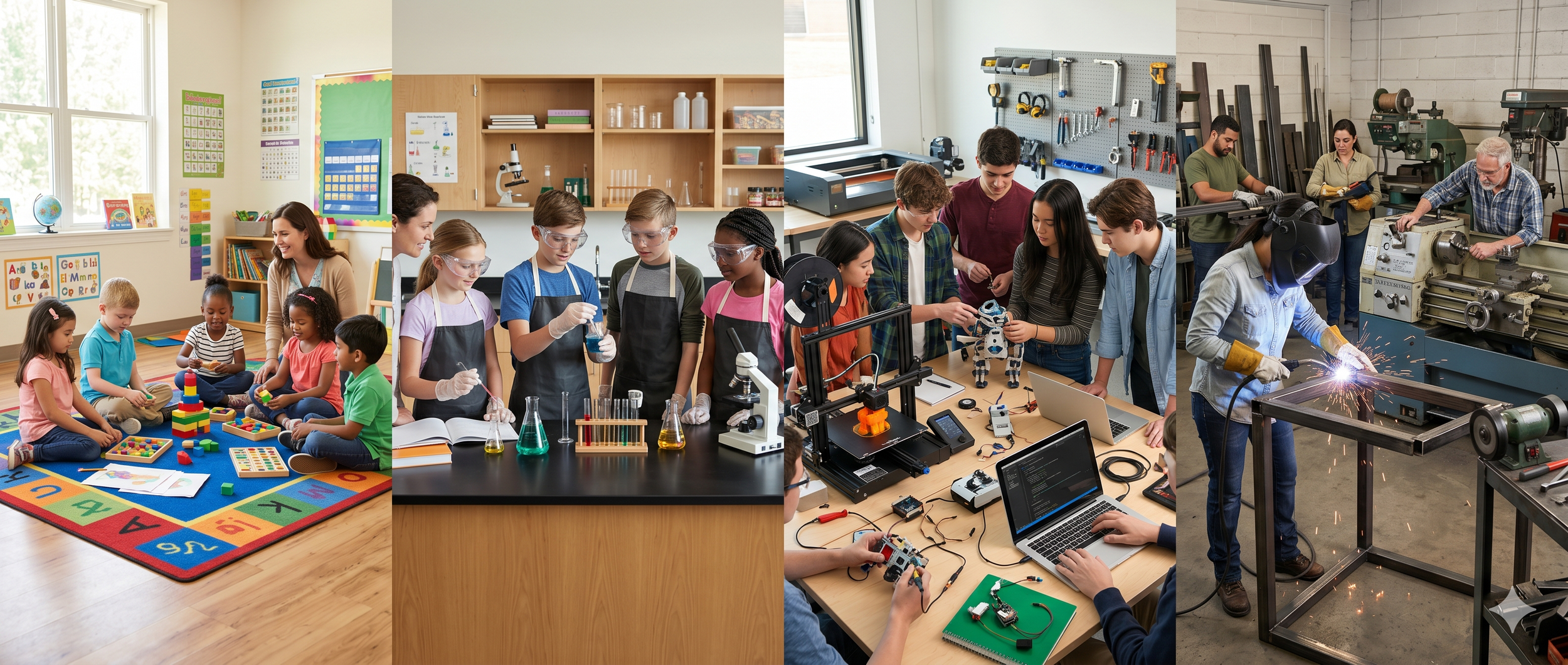
The elementary school's primary work is foundational in the most literal sense. Curiosity, physical confidence, the experience of productive struggle, the social development of learning to be in a community with other people: these are not soft outcomes peripheral to the real work of schooling. They are the conditions that make everything that follows possible. A well-designed elementary environment is generous with space for physical exploration and making, varied enough to support different kinds of engagement across a day, scaled to feel belonging rather than institutional, and connected enough to the natural world to keep sensory experience alive as a mode of learning. It is not a scaled-down version of the buildings that come after it. It is a distinct environment organized around the specific developmental work of early childhood.
The middle school has the most complicated design brief of any building in the K12 sequence, and it has historically been the least well served by the inherited building type. Early adolescence is the developmental moment when identity is forming, social belonging becomes urgent, and the gap between institutional structure and individual need is often widest. The middle school building tends to be neither generous enough for the relational needs of young adolescents nor trusting enough of their emerging capacity for agency. Getting that balance right spatially requires environments that feel neither like the protected enclosure of the elementary building nor the open-ended independence of a well-designed high school: structured enough to provide the safety that early adolescents still need, flexible enough to begin developing the self-direction they are becoming ready for. The supervision-versus-agency tension this series has examined throughout is nowhere more acutely felt than in the middle school building, and nowhere more consequential for what the student carries forward.
The high school receives the student the earlier buildings have been developing. If those buildings did their work well, the high school receives someone with genuine curiosity, practiced collaboration, and a developing capacity for self-direction. That student is ready for an environment organized around application and genuine interdependence: larger project and making spaces, varied room configurations that support different kinds of work at different scales, stronger connections to the community outside the building, longer blocks of time for complex work that doesn't resolve within a single period. The high school organized around those functions looks and feels different from the inherited model, and the difference is most legible to a student who has been prepared for it across the years before.
The planning processes that produce these buildings rarely consider them as a connected sequence. Elementary, middle, and high school projects are planned separately, staffed by different teams, funded through different mechanisms, and evaluated against different sets of outcomes. The result is a system of buildings that are individually defensible but collectively uncoordinated, each encoding its own assumptions about learning and development without explicit awareness of what the others are encoding alongside them.
Beyond the Building at the End of the Sequence
High school graduation has historically functioned as the boundary of the educational institution's responsibility. The student exits and the built environment of learning largely disappears from public investment. What replaces it is a patchwork: the college campus for those who go, the workplace for those who don't, and for many people a gradual withdrawal from anything that resembles a designed learning environment at all.
That boundary has always been somewhat arbitrary. Learning doesn't stop at eighteen. The capacities this series has argued are most durable across an uncertain future, navigating complexity, building relationships, thinking clearly under pressure, contributing to communities, are not developed once and held permanently. They require continued practice across a full human life, in conditions that support rather than foreclose that practice.
The conditions this series has been describing make that continued development more relevant. If AI is reorganizing which tasks require human judgment at a pace that outruns any single credential, the adult who stops developing those capacities at the end of formal schooling is in a more precarious position than previous generations were. The infrastructure for continued learning across adulthood isn't a supplement to the K12 system. It is the logical extension of everything the K12 system is now being asked to build toward.
That infrastructure exists in fragments. Libraries, at their best, are genuine learning environments for people of all ages, designed around access, exploration, and the quiet conditions that sustained thinking requires. Community colleges serve adult learners with a flexibility that four-year institutions rarely match. Community centers, civic spaces, and workplaces that invest in environments designed for learning alongside work: these are pieces of a system that doesn't yet cohere as one.
Given what we know about how public investment in the built environment tends to follow established categories, the gap between the K12 infrastructure and the adult learning infrastructure is unlikely to close without someone naming it explicitly and asking what it would take to design toward it. That's a question for policymakers and planners well beyond the scope of this series. But it begins with the same discipline this series has been advocating throughout: asking what the environment needs to provide for the people inside it, at each stage of their development, rather than defaulting to what institutions have always built.
What This Series Has Been Reaching For
This series began with the observation that the school building was always a design response to specific conditions, not a universal truth. It has moved through the historical record of a reform era that was pedagogically sound but institutionally unsupported, through the human experiences of students and educators and communities navigating a shift they didn't choose, through the spatial consequences of that shift for the buildings being designed right now.
It ends not with a resolution but with an orientation.
The buildings being designed today will serve communities through conditions that aren't fully visible yet. The students who will use them are navigating a world that is reorganizing faster than any curriculum can formally process. The educators inside them are being asked to become something their training and their institutions have not fully prepared them for. The communities around them are depending on them for functions that go well beyond what any building program officially captures.
None of that is a reason for paralysis. It is a reason for the kind of deliberate, honest, human-centered thinking about the built environment that this series has been an attempt to model.
The questions this series has raised, about purpose and people and places, don't get answered in a planning document or resolved in a schematic design. They get answered, slowly and imperfectly, in the accumulated decisions of district leaders who write briefs with genuine honesty about what their communities need, design teams who bring the full weight of their expertise to bear on decisions that will outlast any single reform cycle, and communities who insist that the buildings built in their name reflect the full range of what they value and who they are trying to become.
That work is already happening, in planning rooms and community meetings and design studios across the country. This series is an invitation to bring more of it into the open: to name the questions that have been circling beneath the surface of the AI and education conversation, to examine the assumptions embedded in the buildings being designed right now, and to make decisions that remain useful across the range of futures none of us can fully see.
The door is open. What happens next is up to the people willing to walk through it together.